
With a focus on preservation and affordability, Commissioner Amanda Robertson brings a personal touch to public service in Chatham
Photo by John Michael Simpson
Amanda Robertson has long been a fixture in Chatham County’s civic and environmental landscape. A North Carolina resident for more than 30 years, she’s worn many hats – educator, small-business owner, volunteer and, since December 2024, county commissioner. Prior to this newest role, Amanda sat on the county’s planning board and the Comprehensive Plan Steering Committee, and she helped found the Chatham County Climate Change Advisory Committee. Amanda now champions its priorities from her seat on the board. Her deep commitment to preserving the county’s rural character and natural resources is matched by her focus on thoughtful growth, affordable housing and supporting local businesses.
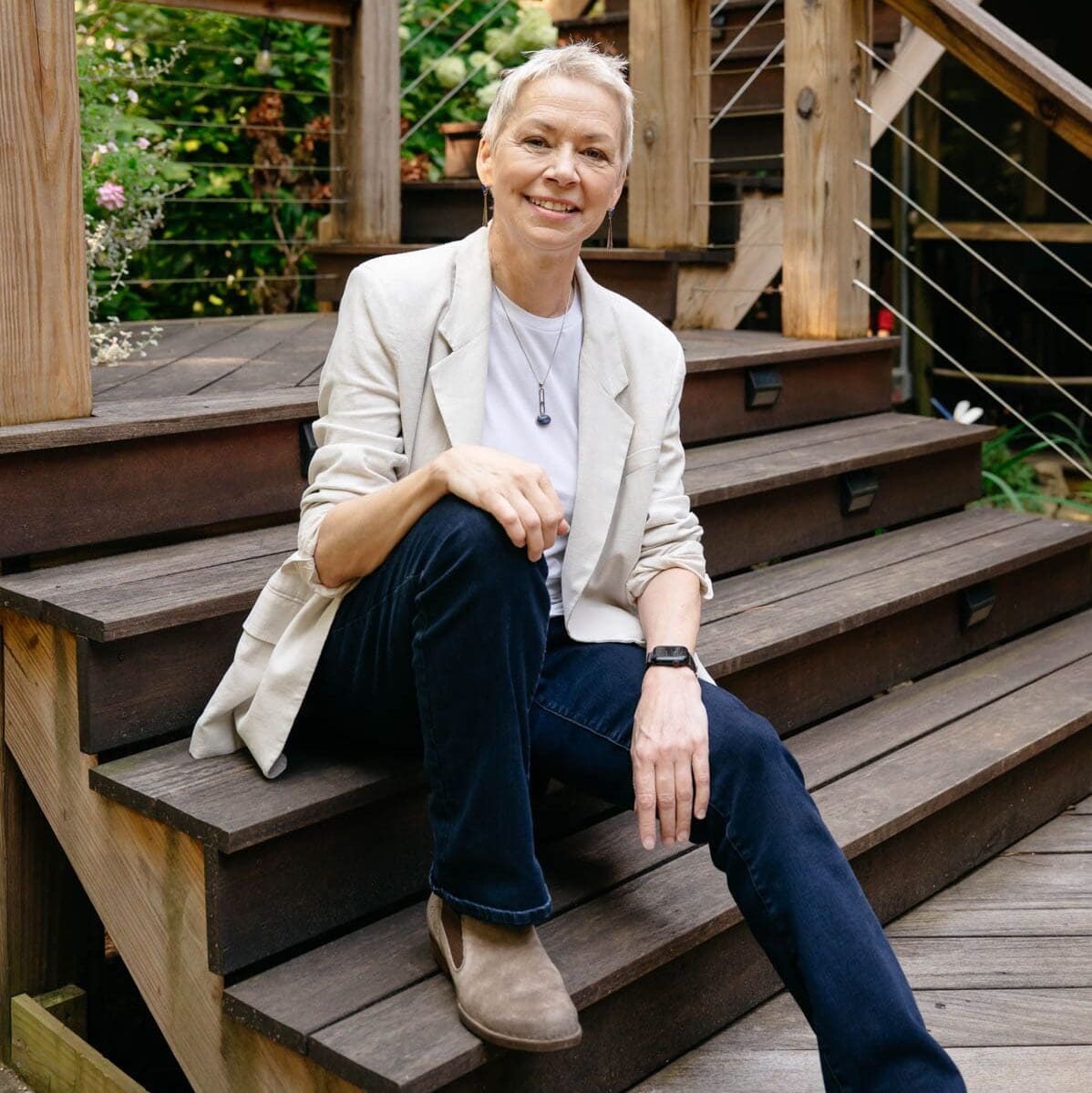
Amanda lives in Pittsboro with her husband, Tony Robertson, and three German wirehaired pointers – Beardsley, Rennie Mac and Moser. The couple’s adult son, Mike Robertson, lives in Miami. She owns educational media design firm The Farthest Pixel and draws on her background in collaborative design to bring a pragmatic, inclusive approach to public service.
Progress & Preservation
*responses have been edited for length and clarity
What inspired you to run for county commissioner, and how do you define a commissioner’s role in growing a community like Chatham?*
Growth. We’ve had a lot of growth. A lot of people are moving here. It’s understandable. It’s a beautiful place. … It doesn’t bother me that the population is increasing. I think it brings a lot of benefits for the people and the businesses that are currently here.
But growth, just for the sake of growth, is not a good thing. It needs to be very thoughtfully done. There’s something that Chathamites know as rural character, and that defines and embodies a lot of different things about what makes Chatham “Chatham” and a great place to live. We need to protect that, and so, in large part, that’s why I ran.
How have your previous experiences as a business owner, educator and volunteer shaped your approach to public service?
I think it’s [all] very similar. When you’re a volunteer, you have to work with other people and collaborate. It’s important to communicate well – to talk to people and to appreciate different viewpoints on whatever it is you’re trying to achieve. It’s the same with teaching. There’s going to be different kinds of people in there, and one way of teaching isn’t going to be the solution for everybody. … And [it’s] certainly [the same] in my business as a designer.
Design is, by its very nature, collaborative. It’s one of the big differences between design and art. We have to reach a solution that has a very similar meaning, if not the same meaning, for everyone. That’s tough. Whereas art can be different for everybody – you can look at a piece of art and feel very differently than I do, for example. Working together for the same end, you benefit from all those opinions, because I may create something and you may look at it and not see it at all. But if I work with you on it, together, we can create something that we both will say, “Yeah, this gets it.”
Policy & Priorities
How has your work on the Chatham County Climate Change Advisory Committee and the planning board influenced how you approach county policy and priorities?
[John Graybeal, Laura Lauffer, Sonny Keisler, John Bonitz] – residents in Chatham who care a lot about climate change – and I put together a proposal [in 2015] … [that we] put forth [before the commissioners] and said, “This is the need.” That was hugely influential for the time and continues on today. They’ve now gotten three studies on greenhouse emissions for the county and [have] presented on how emissions have changed over the years, where we are and what our goals are. … In January – to carry that to the next step – as a commissioner, [I] put forward [addressing climate change] when we set board priorities. It was voted unanimously that, yes, [responding to] climate change should be a board priority.
I suggested we could do something like a climate retreat. The Climate Change Advisory Committee ran with that idea and put together a proposal that will be on the agenda in August for commissioners to review. I believe the retreat is being proposed for October. [That] will be done to establish what all we need to be working on. What are the goals? How can we support residents in areas of climate change and education, clean energy, agriculture … all the things that are in and around the impacts of climate change? … I’m excited about that.
[The planning board] was a really good experience for being a commissioner. I’m very glad to have served. The unified development ordinance (UDO) – a singular document that combines 13 existing ordinances, providing an outline of Chatham County’s revised zoning and land development ordinances – was in the last stages of being finalized [in 2024], and I got to be part of that and make final recommendations to the board of commissioners this past November when they voted to approve it. The Comprehensive Plan came before that in 2018 when I served on the Climate Change Advisory Committee. I was the liaison from the CCAC on the Comprehensive Plan Steering Committee. One of the things that I advocated for in that plan, loudly and repeatedly, was how important climate change was to include throughout that plan. It’s not just a mention – it got in there quite a bit more. It was also included in the UDO that was approved last November.
[Frustratingly], that’s on hold [due to a state bill that affects zoning]. So while we completed our UDO, all of a sudden, now we can’t really implement it because a lot of what was in the comprehensive plan and UDO was doing things with regards to zoning in the more rural areas of the county that would protect some of the natural spaces. So, we just have to see what happens.
Connecting with Community
How do you stay connected to residents and ensure a wide range of voices are heard in county decisions?
I [went] out and met with a group of folks who live between Pittsboro and Siler City out in the country. [I’m] pretty sure everybody at the table was Republican. I’m a Democrat, but they wanted to meet with me and get to know me. It was great that they did that. I think that’s one of the differences between state and national politics and local [politics]. [In] local [politics], you really do serve and meet with everybody. I met with them because they’re very concerned about how they see some of the farms being gobbled up by developers. They’re like, “We bought out here for a reason. We don’t want to have people right up on top of us.” So, we’re very aligned in a lot of ways.
When these new [aforementioned] bills came out, I called them and let them know. Unfortunately, it passed, and then I called again and let them know about new bills coming through, so that they could rally the forces, let people know and call their representatives. I think it’s important to have those relationships. In a time like this, it’s nice to be a local servant to the people, because I can put my focus on local [issues]. I think it’s really important to focus on the things going on locally right now.
As a small-business owner, what do you see as the biggest challenges and opportunities for local entrepreneurs? How does the county support small businesses?
Webb Squared is a great nonprofit that’s focused on the underserved community – primarily people of color – who continue to run into challenges in creating a small business. [I’m a] business owner, yes. I’ve actually done it three, four times now, with different businesses over the years. I’ve gotten to know pretty well, “What are the ropes?” and “What do I need to do?” But, boy, the first time, it’s scary. You don’t know what you don’t know going into that space, and it’s really hard to find answers. It’s even harder to get money to start up. [So] the county actually funds [Webb Squared]. Why can we do that as a county? … When it comes to nonprofits in our county that provide services that the county would provide anyway, we can fund them.
Webb Squared is one area when it comes to supporting small businesses, but there’s a shortage [of support for smaller companies]. The balance [in the diversity of businesses]is totally out of whack, but there is a lot of development here and a lot of opportunities. Pittsboro is growing. Chatham Park is growing. I think, as Disney starts coming in, we will see a lot of demand for space coming up in the business arena. I think it’s going to be probably more of a partnership, working with local folks to ensure that there’s a good balance – that affordability and opportunity are there.
What has surprised you the most in your first year as a commissioner?
One of the things is the diversity of the people. And I don’t just mean race or sex. I mean, across the board, people and their life experiences – all of it. That’s why I love the county that I work in. Because it’s when they have different life experiences, and they come from different walks of life, [that] you get back to that design side [I mentioned earlier]. If we have all these different experiences and thought processes, we end up with a much better final product. It’s the same as a better county in the end.
Our community, when something matters to them, they get out. They raise their voices to the rest of the community, and they say, “Hey, guys, this is out there. The planning board [or] the board of commissioners is looking at this now, we need to get out and say something.” … I think participation of the citizens is critically important. But they can get very discouraged if they speak out [against a development], and it’s something you can’t deny [the developers].
We [can deny] rezonings, [but] if you have a prospective buyer on a property that’s asking for approval on, say, a housing development, and it’s already zoned residential, and they’re not breaking any of the ordinances with their development … [legally, we] have to approve it. [So we] have to look back at, “What do we need to do differently in the ordinances or in the area where this is zoned?” And make changes so that we don’t get saddled with something the community doesn’t want. That’s one of the biggest surprises. People don’t know that. They think that commissioners can just do whatever they want, and we can’t unfortunately.
The Future of Chatham County
Looking ahead, what are the most significant issues you believe Chatham County will face in the coming years, and what legacy do you hope to leave?
Maintaining agriculture and farmlands [will be most important]. We do have a strong farmland preservation program that is fairly well-funded. We coordinate with farmers to help put their farms in trust, so it maintains that land as farmland. We’re at great risk, not just in the county, but as a society, of losing all our farmlands. Developers come in and offer an awful lot of money to farmers to buy their land, and a lot of farmers won’t sell, but [many] often do. They need the money, and they’ve got kids who don’t want to farm and don’t want to inherit their land. It’s a problem. One of the biggest things that I’m proud of is that our commissioners, even before I was there, started thinking about and putting things in place to try and maintain our farms in Chatham County. That’s something we’re going to have to continue to do and work really hard at going forward. There’s a lot of work to be done in that area.
I want to make sure [that people know my focus on climate change] is not all that matters to me. [It’s] probably the single most important thing, because it impacts all of us – but at the same time, we live in the most expensive county in the state to live in – shared with Orange County, back and forth – and it’s not where I want us to be. We have been a rural county. We’ve been an affordable county for a long time. … It is very diverse. It’s diverse in people who have lived here forever and people who have just discovered it and how wonderful it is. It’s diverse in the level of education people have, in what they do. There are farmers, executives, just all kinds of people, and it’s what makes this county so awesome. And yet, you think of how the cost of living and buying a home in this county has gone up so high. … That will impact our diversity.
We have teachers and deputy sheriffs and police and a bunch of the basic workforce that is necessary for a county to be healthy [who] cannot and do not live here because it’s so expensive. … It is very important that we pursue all avenues to make living in Chatham more affordable. That, and supporting our entire community to manage the challenges we face from the impacts of climate change, are two of my top priorities as a commissioner. … [The county also] funds improvement of homes where people already live so they can stay in their homes [through a program called Housing Trust Fund, which awards $300,000 toward competitive grant applications]. … I’m thrilled by that. There are really good things happening, and I’m hopeful. – as told to Sharon Kinsella