
Karen Howard reflects on 12 years as a Chatham County commissioner, her path to public service, and her vision for education, community and local leadership
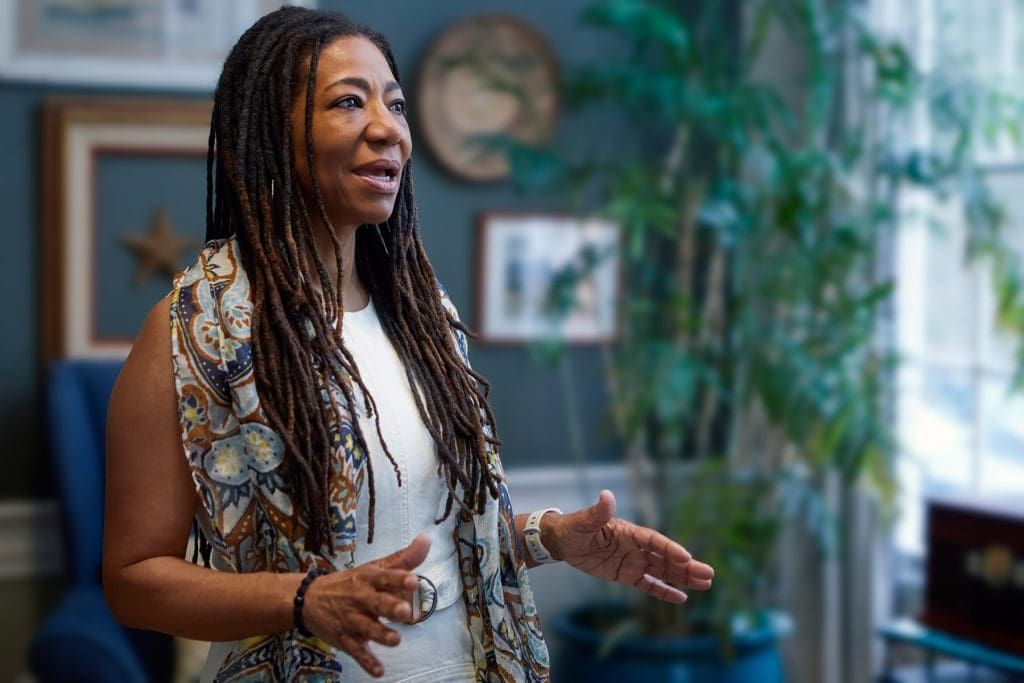
Karen Howard has served as a Chatham County commissioner for 12 years, passionately working to secure a diverse, opportunity-filled future for all residents. She’s lived in many places – from her childhood in the Bahamas to school in Connecticut, undergrad at Georgetown University in Washington, D.C. and law school at University of Buckingham in England – but has proudly called Chatham home since 2007.
Karen lives on the North Chatham side of Jordan Lake with her two rescue dogs, Baxter and Nila. Her six adult children, one daughter and five sons, live scattered between North Carolina, Washington and the Bahamas. She is also a grandmother – or as her 5-year-old granddaughter, Nora Howard, puts it, “glam-ma.” She has an affinity for artistic outlets and in her spare time, paints watercolor portraits, landscapes and stills for friends and family. She also co-hosts a monthly poetry night at The Plant with Lyle Estill and hopes to continue spreading her love of the written word throughout Chatham County. “I deeply believe that if there were more poetry in politics, there’d be less of a divide,” Karen says.
What inspired you to run for Chatham County commissioner?
I first served on the Chatham County Board of Education for two years, and the seat in my district opened when [former commissioner] Sally Kost was leaving. I wanted to continue serving my [school board] term, but I was very concerned about the direction the county was going in terms of its teleology around investing in supporting public education.
As a parent with five kids in the school system, I was seeing direct impact from the way that the then-board of commissioners was thinking about investing in public education; there was this move toward line-item budgeting for the school system. Having served on the board of education, I could see very clearly that there was no way that board of commissioners could identify and define what a good and equitable public school budget looks like without experience or knowledge in that space.
At the time there was also a lot of conversation around what equitable really meant. I was able to look at my own situation, for example, my own kids, and recognize that I couldn’t give the same input to my autistic son that I could give to his gifted older brothers. Equal wouldn’t give him what he needed. It had to be what was appropriate for his needs, for his circumstances.
It didn’t matter that they all lived with the same parents, had the same socioeconomic experience, the same access to food, diet, transportation, housing. He needed an additional foothold in the educational space to meet his potential. That, to me, was such a profound example of why it is important for us to listen to the experts in making these decisions.
There are other things that need to be funded besides education, and they are incredibly important. Things like protection of our environment, affordable housing, transportation needs, public safety – there’s a lot. But for me, public education was so foundational to who we could become individually but certainly who we could become as a community. So that was the sort of the springboard for me to go beyond serving on the board of education and into this larger funding role as county commissioner.
How do you define a commissioner’s role in growing a community like Chatham?
It’s a constant learning environment. The landscape is constantly changing, the needs of the community, expectations of the community are constantly changing, the external pressures are changing. So, to some extent we have to be nimble, but we also have to be solid and grounded in a set of values that reflects those of the community.
One of the things that has benefited me in serving on the board of commissioners is recognizing the limit of my knowledge and experience and expertise. It is my responsibility to learn, to go out into the spaces where the knowledge is available to me. It is my responsibility to accept those invitations and learn, and then to take the information that I can assimilate from several different sources and use that for the benefit of our community.
How does your background as an attorney inform your role?
I was an English major in college, and I remember people saying to my parents, “What is she going to do with that?” My dad would always say, “Anything she wants.” I think that is true of my background in law as well. It provided the foundation for me to sort of dig into spaces where I don’t have a lot of expertise and gain a working knowledge.
I’ve used it when I serve on other boards and committees to understand our role and our responsibilities, to understand the legal responsibility of different roles that I’ve served in. Also, a lot of law doesn’t ever get to litigation – a lot of it is negotiation. The goal really should be to avoid litigation, to avoid the expense of going to court, to see how close the two parties can actually get to meeting their wants or needs. And I think that is true of public service as well.
We are best when we do have diverse perspectives and opinions at the table, and we are forced to compromise. And it does not have to be a compromise of our values; our values are often shared, and those conversations are just often a compromise of the way we go about doing something. So, I think it has helped me in conversation. It certainly has been an asset to me and helping me to articulate my perspectives and help bring people along or help them understand why I feel a particular way.
I encourage anyone thinking about an English major to go for it. The ability to read critically and communicate clearly is a powerful foundation for public service – or any career that involves helping others.
Chatham County has changed in many ways since your first year as county commissioner in 2014. What has been the most surprising change, and in what ways do you hope the community continues to advance?
One of the concrete ways that it has changed is that Chatham County was [previously] unzoned. The zoning in Chatham County only applied around the towns and municipalities. There were a couple of applications that came before the planning board that illustrated that land uses inconsistent with adjacent businesses and homes could too easily be approved in the absence of zoning.
For example, there was an application for a shooting range right next to the Goathouse Refuge, which is a cat rescue. If you are the owner of a cat, you can only imagine how distressing that would be – particularly for the cats who were rescued from difficult situations and were already timid or shy or sick. I thought, there’s no circumstance in which we as individuals would think it was OK to approve a shooting range here. The reality of landownership is that without parameters, and if there’s no opportunity for the public to be forewarned or provide input, you can develop and use your land in any way you want.
So that effort around countywide zoning, I think, was one of the most significant changes that has happened in Chatham County. And we see the benefit when an application that does not fit with the general uses in an area comes before this board of commissioners. We get significant input from adjacent landowners and from people who are going to be impacted, and incorporate that in our decision-making.
The more nuanced change that I have noticed is with the influx of new residents – and we’ve had a significant increase in population. The expectations around what happens in county government have been changing, too. We get more involved in decisions that are happening at the state level, and in Chatham County in particular, we start having conversations with regional partners. When I got here, Chatham County was sort of an outsider in regional conversations around water and transportation. Now, anyone would say that we are really an active participant in the Triangle. We have become one of the big boys now, and I think that’s a good thing for Chatham County because you don’t want to be on the sidelines when things are happening around you that will impact you.
We need to be in conversations now around what transit will look like in 2050 because you can’t wait to get into that conversation when the population is already here. You need the infrastructure and the planning to be able to meet the need and to meet the expectation of future generations of Chatham County residents.
As places evolve, people do, too. How have your policies and perspectives developed as you’ve gained more experience? Have any remained the same?
The foundation of my values and perspectives has stayed the same. I very much believe that ability is far more evenly distributed than opportunity. It is my responsibility as a person in leadership to ensure that everyone has the access to opportunity and that people can advance and grow into their greatest potential.
Also, I continue to have a very clear understanding of my role and my place in the fact that the county is growing. I am one of those people who came to Chatham, and I’m a part of that growth. Respecting and honoring the community that I moved to means understanding that part of my responsibility is not to close the door to future residents, but to make sure that as the population grows and changes, we are respecting the things that brought us here in the first place. The quality of life that lured us in should not suffer because we are here.
I do deeply believe that people who have moved into Chatham have been an asset. We have incredible philanthropy and volunteerism and active participation on boards and committees because of those people. At the same time, we have to respect the community that we moved to in ways that demonstrate that.
How do you stay connected to residents and ensure a wide range of voices are heard in county decisions?
I make sure that I am always accessible. If anyone invites me to do anything, my answer is always yes. I will figure out the how and when afterward. I think that’s the beauty of local government and a smaller community: that you can be available to people. I’m always happy to come and speak to community groups or individuals to have coffee. I’m very comfortable explaining my why, and I think most people who have reached out have been open to us, not necessarily agreeing when we walk away, but understanding each other’s perspective.
The county government as a body does a good job of ensuring that we have public comment available at our board meetings, that we’re listening. We’re often not able to engage directly with the members of the community, but if there is something that needs to be followed up on, we do, whether it’s through staff or through a board member. I hope it feels to the community as though our door is open. We try to have meetings in communities that will be affected; for example, with the Plan Moncure small area plan, we made sure that we met in Moncure.
You are currently serving as chair of the Triangle West Transportation Planning Organization. How would you describe your long-term transportation goals?
So, [Durham-Chapel Hill-Carrboro Metropolitan Planning Organization] is now the Triangle West Transportation Planning Organization. We rebranded last year. It’s the same group, we just thought that the new name better defined who we are. In terms of Chatham County long-term planning goals, we have not had a comprehensive transportation plan for Chatham, and we are now going through the process developing that plan. Because, like I said, we’re not going to get the infrastructure that we need in place for the people who want access to transit, unless we are in those conversations now and preparing.
We have a robust planning department. We have transit staff who are involved in the conversations with Triangle West, and we are beginning to build out what our expectation of transit in Chatham County looks like. How does it grow from the small microtransit we’re trying out now into something more robust and something that’s countywide? People have got to be able to get to wherever they need to go, whenever they need to go there and ideally reduce the number of cars on our streets. I think that is everyone’s goal.
You have also served two terms as the chair of Chatham County Board of Education, and on the admissions committee for UNC Kenan-Flagler’s MBA program. How did those leadership positions influence how you approach county policy and priorities?
Serving on the board of education was foundational to how I see my role as a county commissioner. In our schools, outcomes for students are almost always tied to their economic and family circumstances, and these social challenges can show up in the classroom. The responsibility of public education is to meet every kid where they are, so investing in Chatham County Schools is truly a way to lift all boats.
I have personally seen the benefit of meaningful investment in public education. Chatham County Schools is one of only a tiny handful of school districts where every school met growth expectations, and in public education, growth is everything. Each student, whether they are the smartest child in the classroom or the child who’s been struggling most, is making progress. For that to be happening across the district is remarkable, especially given where we were when I first started on the board of education in 2012.
The increase in teacher pay is helping us keep good educators in the classroom. When teachers feel valued, where school communities feel as though they’re being heard, where our superintendent feels supported by the board of education and by the school staff – all of this has gone into creating an environment where young people thrive. I also want Chatham County Schools to be the kind of place where young people can say, “I can see myself in education. I can see myself going into teaching.” We can’t afford for the profession of teaching to fade.
My work on the UNC Kenan-Flagler admissions committee influenced me in a different but equally important way. Interviewing MBA candidates coming from such different spaces, from different professions, from different backgrounds showed me the power of diversity of experience.
I interviewed a candidate for the business school who was a CEO at an oil manufacturing company, and then another person who had started her own business in hair care products. It’s just such a stark and constant reminder that our differences and the uniqueness of our expertise and experiences are not a disadvantage, but our strength – not just in local government and not just in public education, but in every way.
What are current goals you have set for your work, and how do you plan to achieve them?
Short term, we are in the early process of developing a county climate action plan. The development of that plan is short term, but the implementation is going to be long term and will be a valuable asset to us with the development coming into Chatham.
I do believe that we have to increase the number of households that we have. We have got to build some affordable housing muscle, which means more units, more houses, more apartments with higher rises – maybe three, four, five-story apartment complexes. But to do that in a way that does not detrimentally affect the environment, we must have a plan on how best to develop and implement erosion control methods and climate mitigation strategies, so that as we grow to meet the demands of a growing population, we are not creating environmental hazards.
What keeps you motivated and passionate to continue this work?
I really believe that we are a community that is invested in our individual capabilities. I believe that Chatham County wants people to do well. I have served with people who demonstrate that again and again. I am hopeful when my board and my colleagues look at our budget, we think about it as a way of supporting individuals and families and helping people meet their potential. I feel as though I wouldn’t want to do this anywhere else.
Chatham County has a sense of community that makes me feel comfortable being in politics in these really complicated times, and even the times when we disagree and there has been vitriol, I feel supported by the large majority of the community. That keeps me hopeful, that keeps me motivated. – as told to Rebekah Mann